The Night Frank Colacurcio Jr. Came to Seattle Vice

Posing with Frank Colacurcio Jr. with Ray Tagavilla, Mark Siano, myself and one of the women (perhaps another Colacurcio) who attended the show at The Triple Door.
“Do you have time to step out and take a photo, Frank Junior is here!”
I hop off the bannister leading out of the Triple Door cabaret theatre and hand the moldering violin case stuffed with tip money to Katheryn, who takes my place as the full house files out. I’m wearing a stripped-down version of my Jenny Durkan costume, complete with the blonde bob wig, that ends my performance in the show.
Mark is wide-eyed and sweaty as he leads me over to a silver-haired gentleman in a dark suit. He shakes my hand, and we pose for a photo. He stands next to actor Ray Tagavilla, who played his father—the notorious Stripper King Frank Colacurcio—in our cabaret musical Seattle Vice.
Frank Jr. is accompanied by a large group of beautiful women, all petite, with slicked-back updos and understated evening wear. They hand out free-entry cards to Kittens Cabaret, a nightclub in Georgetown where they work.
Mark is mobbed by the ladies. He’s telling them how he came to Kittens to pass out flyers for our show. Yes, he was offered a dance. Yes, he’s excited they came.
After the photo, I find myself standing alone. I decide this opportunity won’t present itself again.
I walk over to Frank Jr. and ask him if he enjoyed the dancers. Seattle Vice featured three “stripper” acts, all professional aerialists at the top of their game.
He liked them very much, he said.
“You’ve been doing this show for five or six years now? I’ve heard about it.”
I’m flattered. This is the fourth production we’ve done of the story of his family’s life.
“We want to be respectful. We know this isn’t just a show to you.”
“Eh,” he shugs, “It happened.”
I tell him how we met Rick Anderson, the reporter who wrote Seattle Vice, at the Ship Canal Grill, and how he gave us the rights to use his book as inspiration for our show.
He smiles.
“My Dad hated Rick Anderson.”
“Was that because of the media attention?”
“No, no, he loved the media, he loved the spotlight. I think it was that they had a falling out over a girl…”
Oh. Now it’s getting good.
We chat a bit more, and I tell him that when Rick came to see the first production of our show at ACT Theatre in 2014, he gave me two champagne flutes.
“When your father passed away, there was an estate sale. Rick and his wife came by, and bought those glasses.”
“That’s right,” he murmurs “My Mother had the sale. Rick was there. That’s interesting.”
And suddenly, the distance between the history we researched and the history that actually happened feels very, very small.
Now, you may wonder why I’m so excited about speaking to Frank Colacurcio Jr. He’s hardly a role model for my son. The reports in Seattle Vice tell the story of a ruthless businessman who inherited his father’s skin-selling empire. After Strippergate, the family even lost the rights to profit from telling parts of their own story.
But this is a living, breathing person who came to see my show.
He’s also walking history. And if you put out a casting call for Italian mob boss, he would fit the bill.
The hairs on the back of my neck, underneath my cheap blonde wig, are standing on end.
For a playwright and performer, meeting one of your muses is simply very cool.
The gentleman standing next to Frank, hands folded politely in front of his body, gives bodyguard. When I introduce myself, he tells me he’s the manager of Kittens Cabaret and that I’m welcome to come by anytime.
Then Frank stops and looks at his phone.
I see he has pulled up the Venmo QR code we put in the programs for audience members to tip the performers.
He says, “Is $1,000 a good tip? For the performers.”
“Well, that would be a great tip. We consider it a good night if we clear $2,000 from the entire room”
I gesture toward the 250-seat cabaret theatre.
“$2,000, then”
He shakes my hand.
Later, in the dressing room, the cast cheers and toasts with champagne when Mark sees the Venmo notification.
$2,000.
From Frank Jr.
There is something almost too perfect about it.
We’ve just performed a musical about strippers and bag men, and here we are, musical theatre performers passing around a tip jar ourselves. People perform. People watch. Money changes hands.
How different is it?
This particular run of Seattle Vice wasn’t profitable. There were plenty of reasons: summer show dates, World Cup fever killing our early ticket sales, maybe even a show about sex work landing differently in Seattle now than it did in the 2010s. The pendulum swings.
We had been struggling to make the numbers work, wondering whether all this labor was financially worthwhile.
And then a man we had turned into theatrical history walked into the theatre.
He watched an actor play his father. He watched aerialists become our version of dancers at his clubs. He listened to jokes and songs inspired by a history his own family had lived.
And then he tipped the performers $2,000.
Yes, quite literally, that was money in our pockets. For working artists, that matters. I’m not going to romanticize that part away.
But the money isn’t what I’ll take to the bank.
I’ll remember standing there in my Jenny Durkan wig, talking to someone who had previously existed for me in newspaper clippings, books, court records and stories. I’ll remember the strange thrill of realizing that the history we had been playing with for years was still alive enough to walk through the doors of the Triple Door, shake our hands, correct a detail, tell us a story we didn’t know.
Maybe that’s one of the reasons I keep making theatre. You research something. You obsess over it. You turn real people into characters, history into songs, scandals into punchlines. You spend too much money and lose too much sleep trying to make the whole thing live for two hours underneath the limelight.
And every once in a while, the story talks back to you.
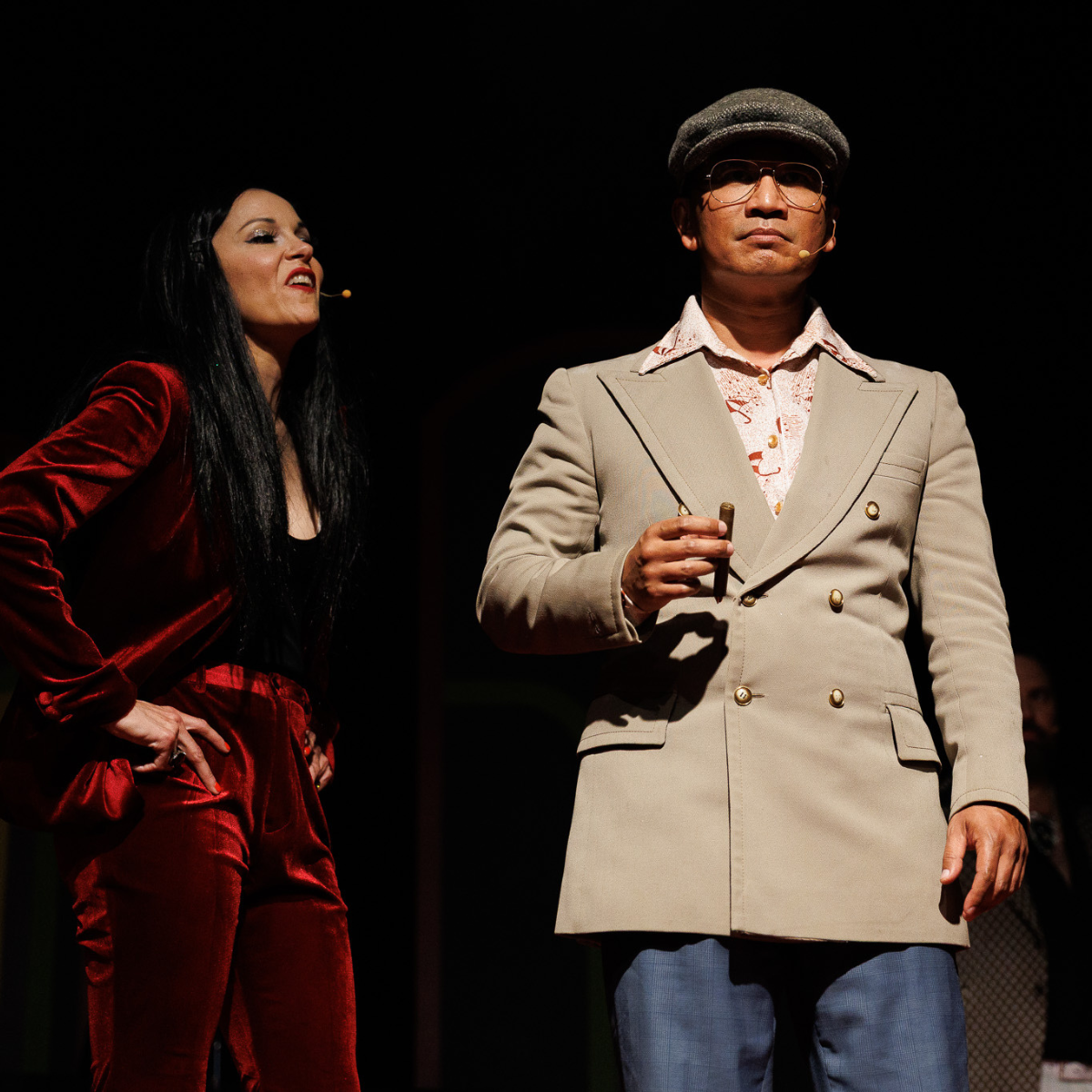
Myself as Rose Marie Williams and Ray Tagavilla playing Frank Colacurcio in Seattle Vice, 2026. Photo by John Cornicello.