The Family Business
“I'll race you on my rollerblades. Let's see who can go the fastest.”
My sister jumps out of my mom's Nissan Stanza and races down the sloped and bumpy driveway of the Kent Masonic Hall Center’s parking lot. I follow after, but I'm on my brakes. My sister is much more daring than I am. We race back up, and once is enough for me. I take off the rollerblades and follow my mom into the kitchen. She’s unloading big cardboard boxes from Costco. We’ve been there and back before 10am. You can only shop at Costco early when you have a business license, and my mom has been moonlighting for a few years now. Boxes of Duncan Hines brownies. Huge cans of whole tomatoes. Bags of elbow pasta. Cabbage heads to make our homemade minestrone soup. Big cardboard tubs of vanilla ice cream to serve with the brownies. Frozen Tostino’s personal pizzas.
All of it will be sold at my mom’s Saturday night jazz club.
It’s the Jazz Café in the Kent Masonic Hall, and my mom is a one-woman band putting everything together. She has a board of directors and a grant from the NEA—yay 1990s, when we still had such things—that allows her to bring isome of Seattle’s best jazz musicians to our sleepy suburb.
There’s no bar. My sister and I serve as waiters, taking cash at the door for brownies and soup and popcorn, popped in the microwave in the back kitchen and shaken into paper napkin lined wicker baskets.
The jazz doesn’t start until evening, but our Saturdays begin hours ahead.
Eventually, my sister and I get bored with Mom and the cooking and disappear into the enormous temple of the Masonic Hall. There are framed pictures of men with beards and, in one of the back rooms, an old coffin.
I always try to pick its lock with a bobby pin. No luck, again. At thirteen. I’m a lover of Nancy Drew books and the tunes my mom sings at night.
I don’t know it yet, but I’m also learning how a show gets made.
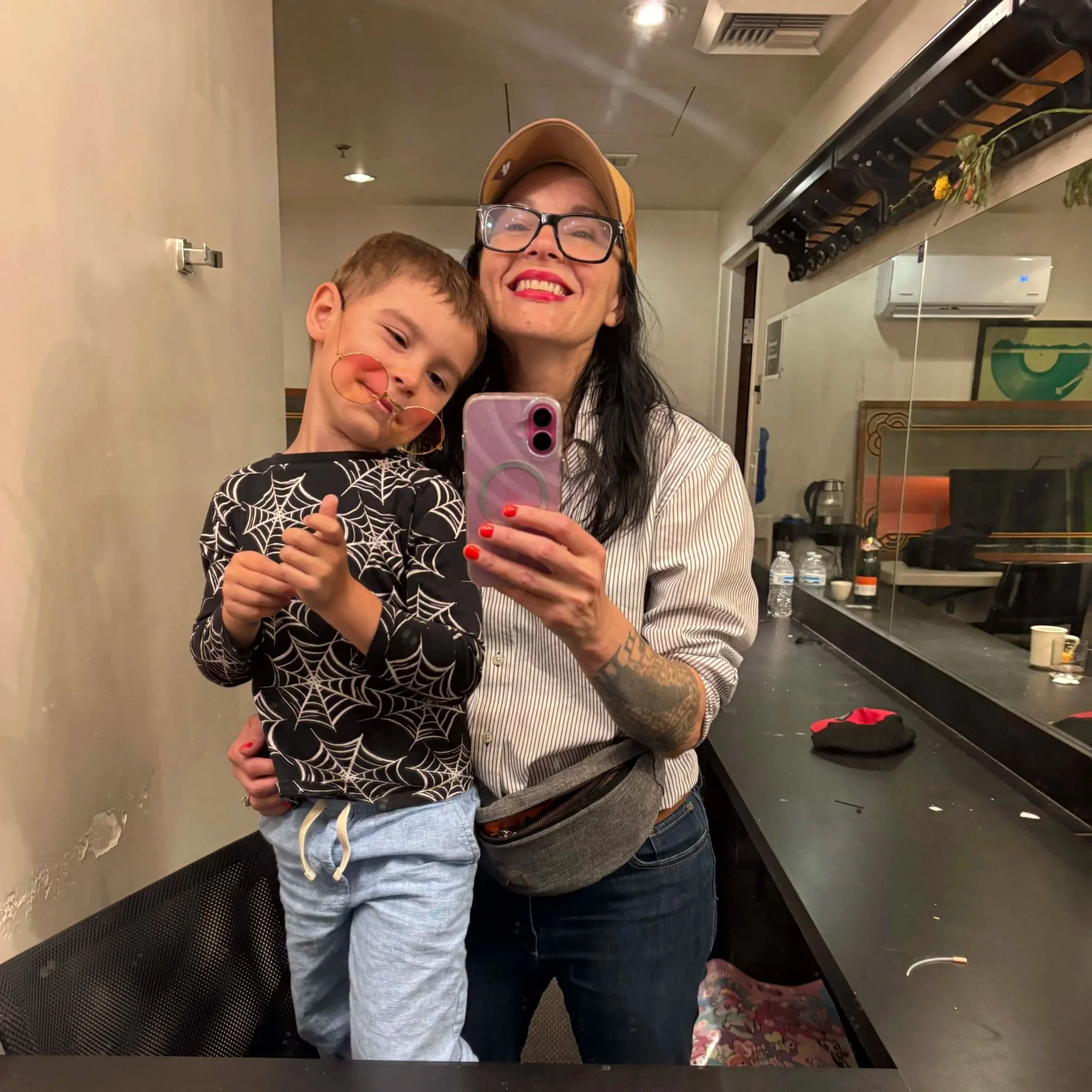
Hero and I backstage at the Triple Door after completing strike together.
Thirty Years Later
I pack my car full of props and costumes and strap my five-year-old son into his car seat. This last series of shows at the Triple Door was a banner year for me. It marked the first load-in—and strike—that Hero participated in. He brought toys and coloring books and sat in the booth doing paint-by-number dinosaurs while I hung costumes and delegated tasks. Then, when the show was over, he was there as we packed everything up again to go home. As I write this, he’s enjoying the last week of summer before Kindergarten.
Somewhere along the way, my baby became old enough to help with the family business.
“Mama, let's go to the top of the parking garage. Can we do that?” As we drive into the Union Garage, next to the Triple Door, it’s on the tip of my tongue to tell him no. We have to hurry. I usually grab the closest spot to the elevator. Second or third floor. Coveted. But then I think, why the heck not? It turns out the massive parking garage goes up ten stories. I never would have known.
At the top, I unbuckle my son. The wind from the Puget Sound whips my hair while we marvel at the landscape of glass buildings surrounding us. Some are as old as the city itself; others are so new I gasp and shrug my shoulders, wondering how I missed these huge buildings being built this last decade working at the downtown cabaret.
Hero was right. The top floor was an excellent idea. And maybe this is part of what I’m trying to learn as we prepare as a family for the big push into the school system: The show is not always the important part. Sometimes it’s the trip to the top of the parking garage.
The Roar of the Greasepaint
“I think I'm just addicted to the adrenaline.” My co-producer Mark smiles at me ruefully as we look at the numbers for our Seattle Vice run at the Triple Door. After getting on our knees and begging—virtually, of course—for people to come see our show, and lowering ticket prices, we are watching the numbers skyrocket. Full houses!
We’re getting closer to breaking even, give or take five thousand dollars. It is a rush.
And suddenly, I’m thinking about my mother. When she ran the Jazz Café, there were meetings with the board about the budget that drove her to tears. Eventually she closed the club night and filed for bankrupcy for that business. She would hang her head and call herself a failure.
I never thought so. Those evenings of jazz in my early teens were some of the most exciting nights of my childhood. Watching my mother pull everything together from sunup to long after midnight was inspiring.
I thought she could do anything. And that, despite the tears, it would all turn out okay.
What Do Our Children See?
“It's always stressful. It's always hard. Ticket sales always stress you out.”
My husband raises his eyebrows at me.
There’s the new show, Bootlegger’s Ball, and I’ve been telling him how excited I am that ticket sales are good. Of course, there’s always the caveat: we only have five performances. Five performances can’t possibly pay for all those performers, costumes, musicians, props…
I think about what Mark said about the adrenaline. I don’t want my family to think I’m on a constant roller coaster with my career. Nothing ever good enough. The next show, the next ticket sale, the next opening night. Only worth it for the heights of performance. Always on the brink of ruin.
But isn’t that, at least a little bit, why we do what we do? For the rush. So how do I share the good things with them? The sweet things?
How do I share the feeling of being onstage in a show that I wrote and created and stitched together from sunup to long after midnight? How do I share that with my son?
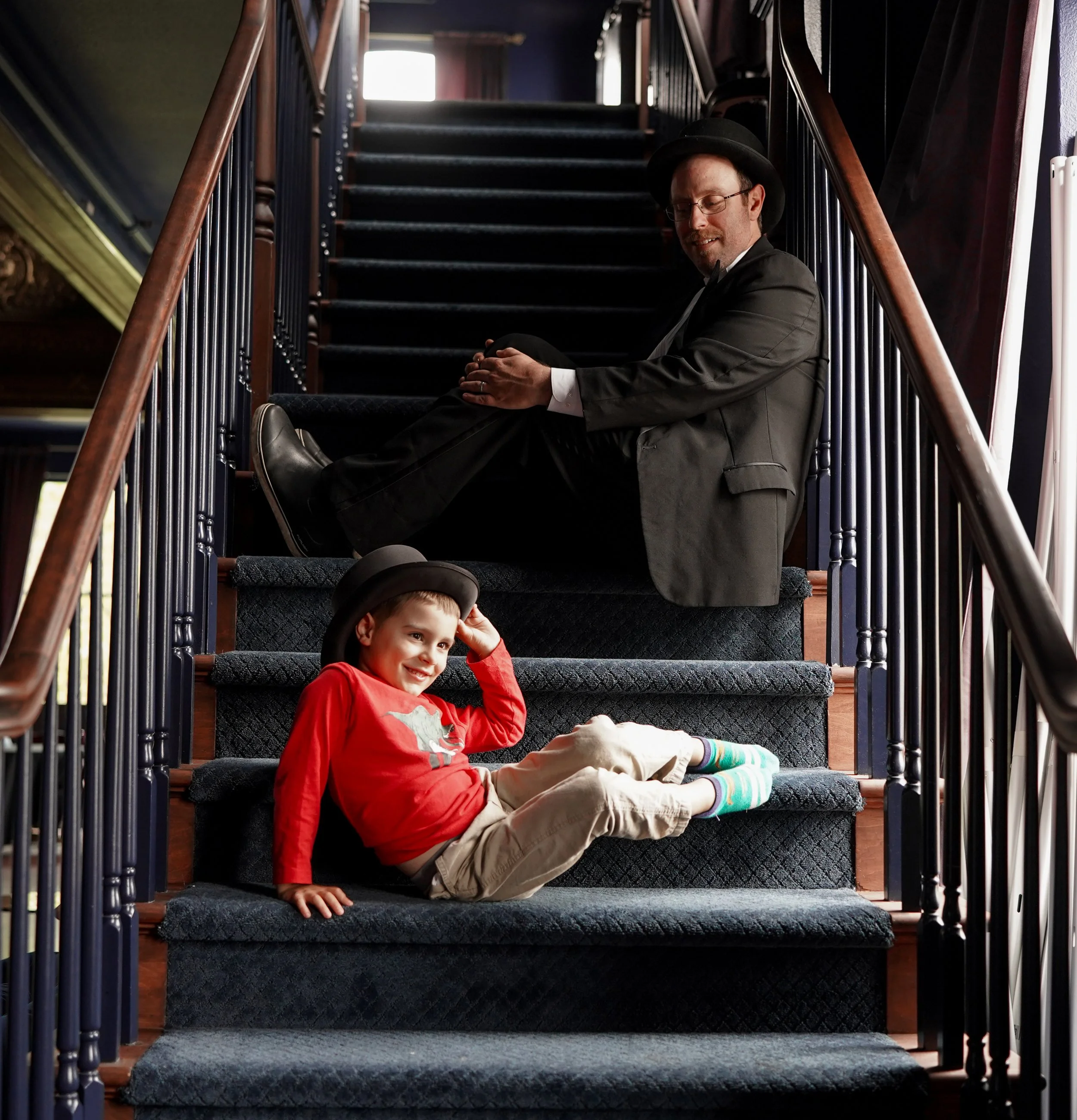
Hero and Christian behind the scenes at my photoshoot for Bootlegger’s Ball at Oddfellows Hall. Photo by Wren Morrow.
Limelight
I have to believe my mother set out a pattern in stardust for me. She never called herself an artist, in those words. She did show me what art required.
We carried the boxes. We served the soup. We explored the strange old building while she worked. And then the musicians arrived, and the audiences with their hollers and applause.
Now, I want Hero and Christian inside my theatrical life, too. Not necessarily onstage—although Christian did come onstage opening night of The Fairy’s Bottom as Bottom, the Ass. I created the audience-interaction role specifically so that my husband, a chef and definitely not an actor, could be the first person Titania fell magically in love with.
I played Titania.
It was exciting for all of us. But maybe the more important inheritance is the schlepping. The boxes and Tupperwares. The costumes that have to be organized when they return to our small house’s attic. The photo shoots and parking garages and hours when Mama has to work but we can still be together. They don’t need to do the budget with me. But I want them to see what happens when a show succeeds. Sometimes I spend that money on vacations. Sometimes presents for my son. Whenever possible, I spend it on the thing I want most: time with them.
That is the greatest wealth I could ever hope to achieve from a career in theater.
For Bootlegger’s Ball, Hero and Christian took part in the photo shoot that got our tickets on sale. It was mainly for me—my show, my idea, my ridiculous schedule—but on a stressful day, there they were, running through the Grand Ballroom in an Oddfellows Hall.
Thirty years ago, I was the kid rollerblading through a Masonic Hall while my mother unloaded the Costco boxes. Now Hero is five, and he moves through my theater while I build the next show. A part of it.
Maybe one day he’ll remember these shows. Maybe he won’t. But I hope he remembers that Mama made limelight and stardust. That sometimes it was stressful. But most times, Mom said yes, let’s go to the top of the parking garage instead of taking the convenient spot.
And that when we got there, I stopped hustling long enough to look at the view with him.