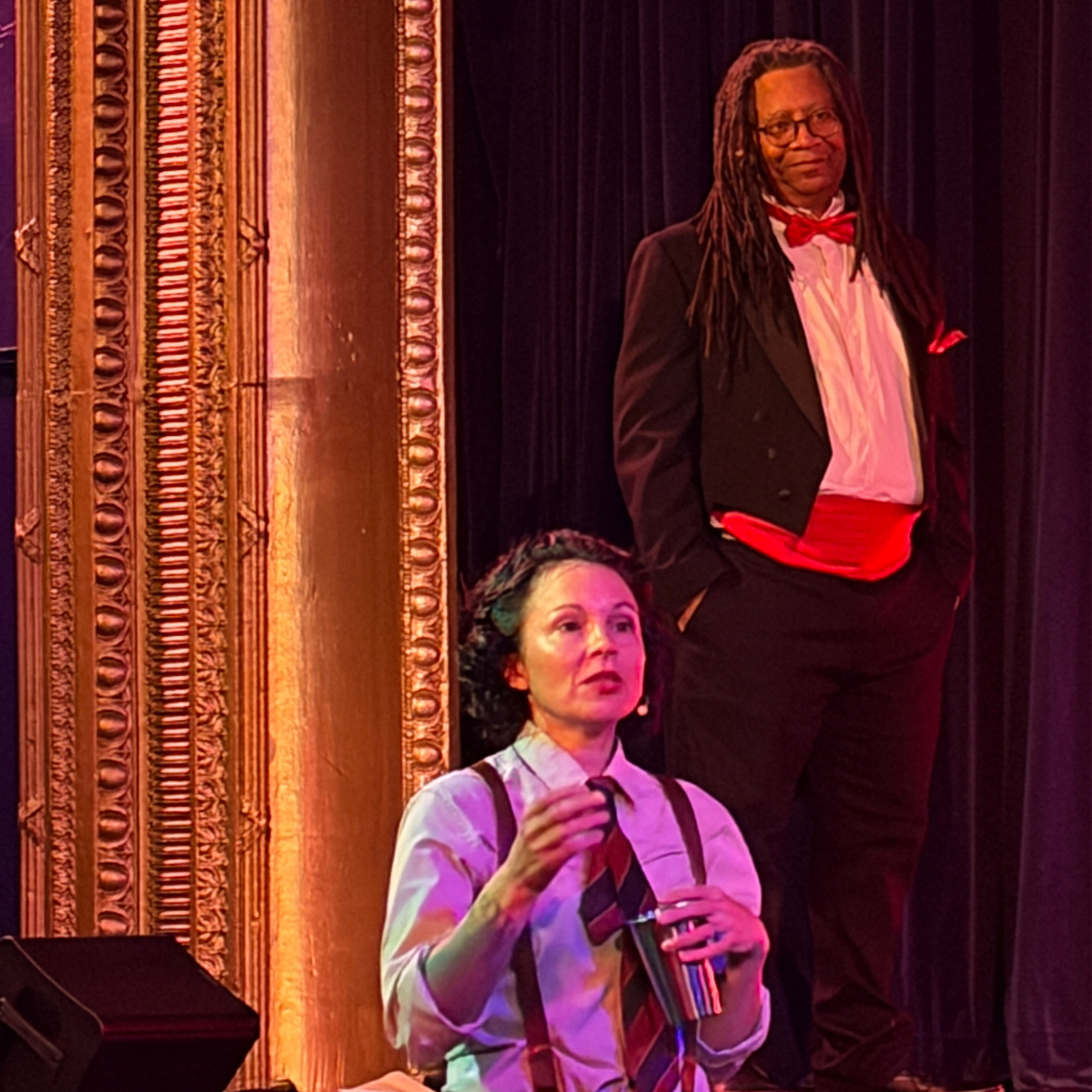
A candid shot of me addressing the cast during tech rehearsal
Imagine with me that I got my dream interview at KOMO for Bootlegger’s Ball.
Why KOMO? KOMO Radio has a fascinating connection to the radio station KFQK, once owned by Roy Olmstead, Seattle's most popular bootlegger. The station's history is tangled up with the very Prohibition-era stories that inspired my show. Now, don't get distracted. I would have loved to tell that story on the air, but I never got the chance. This is my blog, so you're going to play pretend with me.
So here I am at KOMO—now TV and not radio—at 7 a.m., ready to report to you all on my latest creative balancing act. I'm looking fabulous in my vintage Lily Yang dress suit, pulled from the back of the costume racks that live in my attic, it’s been years since I last appeared on television. The production assistant puts on my microphone and instructs me to focus on the host, not the camera. I’m feeling good, ready to speak to my city. In my fantasy, I have the calm that rarely accompanies a live performance. In real life, I would have crunched a beta blocker in the bathroom.
The host smiles with abundant makeup and curly girl perfection. “So, Opal, our audience is eager to know. Your show Bootlegger's Ball is a success, what are the highlights?”
The highlights are brightly colored, and look a lot like our fabulously dressed audiences. I think of the way I was treated by the staff at the ballroom after it was clear the show was a hit. “It’s so wonderful to see you doing your thing.” our operations manager commented, in the front room with our event coordinator on Opening Weekend. I’ve felt like I have something to prove to the Ballroom this past year doing their marketing, and trying to sell my show ideas. But I don’t share that with our TV host. I smirk.
“Actually, it was the big laugh line I got when my announcer character spoke Roy Olmstead’s first radio broadcast, as the first and the only radio station in town. Then, I said “Fuck you, KOMO”. Pardon my french, but it brought the house down.”
If my dream host is strained, she doesn’t let on. “Despite the laughs and sparkles, as a mother, what would you have done differently?”
I think about the first month of kindergarten for Hero, three weeks in, when I started rehearsal for Bootlegger’s Ball.
I was driving home on a Tuesday night at 10:30 p.m., putting myself to bed as quickly as possible with a cup of Sleepytime tea and my Kindle. But six hours later, my son was calling for me, ready to start the day. The new kindergarten routine meant he was ready for bed at 7 p.m., right after I left for rehearsal, and up between 5 a.m. and 6 a.m. Struggling with my sore feet and a full brain, I would get breakfast, make lunch, and then he was out the door with his dad.
Let's smile together at the irony of my imagined interview, where I am looking fabulous in contrast to Mom in sleepy pants who can't find a hair tie to save her life. That is the theatre, right there.
“I would flip the script on evening rehearsals. They are really difficult for artist moms. As a producer, I should be able to find blocks of time in the weekday that works for my team of actors. Hardly any of us work a nine to five, why must we rehearse evenings? What would a rehearsal schedule designed around our lives look like?”
It's a question I keep coming back to. As a producer, I'm the one who helps create the schedule. I'm also the one trying to survive it. If I know this process is difficult for me, why do I keep arranging it the same way? Of course, there are actors with daytime jobs, families, and other commitments to consider. There isn't one perfect schedule for everyone. But perhaps there is a better way to begin the conversation, before the rehearsal calendar is already set and we're all committed to making it work.
The host smiles sympathetically. I wonder if she has kids. I remember something parents said often to me before I was a mom. “You don't know what love is until you have a child.” I'd roll my eyes. Now I'm there with the groveling, unexplainable, desperate adoration that comes with being a parent. The host, and thousands in my dream television special, are witnessing it. Maybe they recognize it in themselves? Maybe not.That adoration has changed the way I measure my time. I love my work. I love the people who make it with me. But I also love being home when Hero goes to bed, and waking up with enough energy to enjoy him.
I don't want to have to choose which love gets the best of me.
Next question:
“What got you through the hard parts? The lack of sleep? Working two jobs on top of producing and creating? Being there for your son and your husband?”
I smile and think of Christian, my Sweetie the Chef. He's home more, meal prepping, clipping coupons, walking our son to and from school. His new job as a part-time cooking class instructor has allowed him space to find what’s important. Fortunately for us all, it’s our daily routines and saving time and money! During Bootlegger’s Ball Christian was present in ways that were difficult during his years working in restaurant kitchens. And I can give more of myself to my work, knowing Hero is spending that time with his dad. But in the moment, the glue that pulled it all together was some simple advice that I hope to share here: two words, yoga nidra.
I have a cot in my attic office. It is the eye of the storm amidst the clutter, with a striped-down blanket and a circle of hardwood floor that somehow remains pristine. If you've read my previous blog about the power of the flail, you know I build 40 minutes into my workday routine for puttering around. On those tired, mentally full days when I was up early on just a few fumes of sleep, I would light a candle, dim the lights, and listen to a 30-minute yoga nidra for overwhelm or muscle relaxation. I'm linking the Spotify podcast Intentionology which I used during this rehearsal process.
This yogic meditation pulls me deep beneath the waves almost instantly. Somewhere between a nap and a meditation, these sessions are a lifesaver in the stormy seas. Ten years ago, I would have smoked a bowl, or dissolved into a glass of wine, or eaten a bag of jelly beans. It has happened softly, but those vices have quietly left the room, leaving me with myself to relax myself. It's essential. I can't always change the number of hours in a day, but I can change how I use them. I can stop treating recovery as something I have to earn after the work is finished.
And one final question, the host smiles:
“What's next?”
I think of my lead actor, sitting on the Reverie Ballroom office couch applying his makeup and telling me: “I am so grateful to come here and forget everything about the world outside and do this show with you people.” That's it, isn't it? That's the reason I do this, and do this again. The wonderful people who come together to create something that didn't exist before. The friendships, the discoveries, the magic of being in a room where everyone has agreed to believe in the same impossible thing and come together on the century old dance floor.
I want more of that.
Yet somehow, in the bright studio of my dreams, my eyes focus on my black backpack, tucked just out of the camera’s view. I've folded the straps and slipped them inside, using a zipper to transform it into a large purse that's more professional. But I know what's there, lurking. It's my Type B personality. It's filled with crumpled papers, bags of clothes and costumes I no longer need but hold close for the memories. From the outside, it looks rather put together. Inside, it’s a hot mess of everything I forgot I decided I needed to get through the day. It has been six years coming. Six years of motherhood, making shows, taking jobs, rearranging schedules, saying yes to opportunities and figuring out how to make them all fit. And now it's time for a great re-sort of myself, to find what's most important and toss the rest.
“Postmortem,” I say.
That's what we call it in the theater. We ask questions after every production. What worked? What didn't? What would we change? We examine the budget, the rehearsal schedule, the technical challenges, the ticket sales. But how often do I apply that same thinking to the way I make the work?I know how to produce a show. I know how to assemble a team, find a venue, build a budget, sell tickets, and get everyone to opening night. What I want to learn now is how to build a process that supports the people making it, including me. What if I began with the lives of my collaborators instead of the traditional rehearsal calendar? What if rest was built into the production schedule, rather than something we all desperately needed afterward? What if I gave myself permission to change the rules I've been following for years?
I need to remember that I'm the producer. I have more power over this process than I've been giving myself. For an artist mama, the black bag is a little frightening. There's so much inside it that I've carried for years, some of it precious, some of it no longer necessary. But it's my job to open it. To sort through what's there, to keep what I love, and to let go of what no longer serves the life I'm buildingBecause the next show will come. I can already feel it itching my brain. And this time, I want to make room for the work, for my family, and for myself before I zip the bag shut and carry it all home.
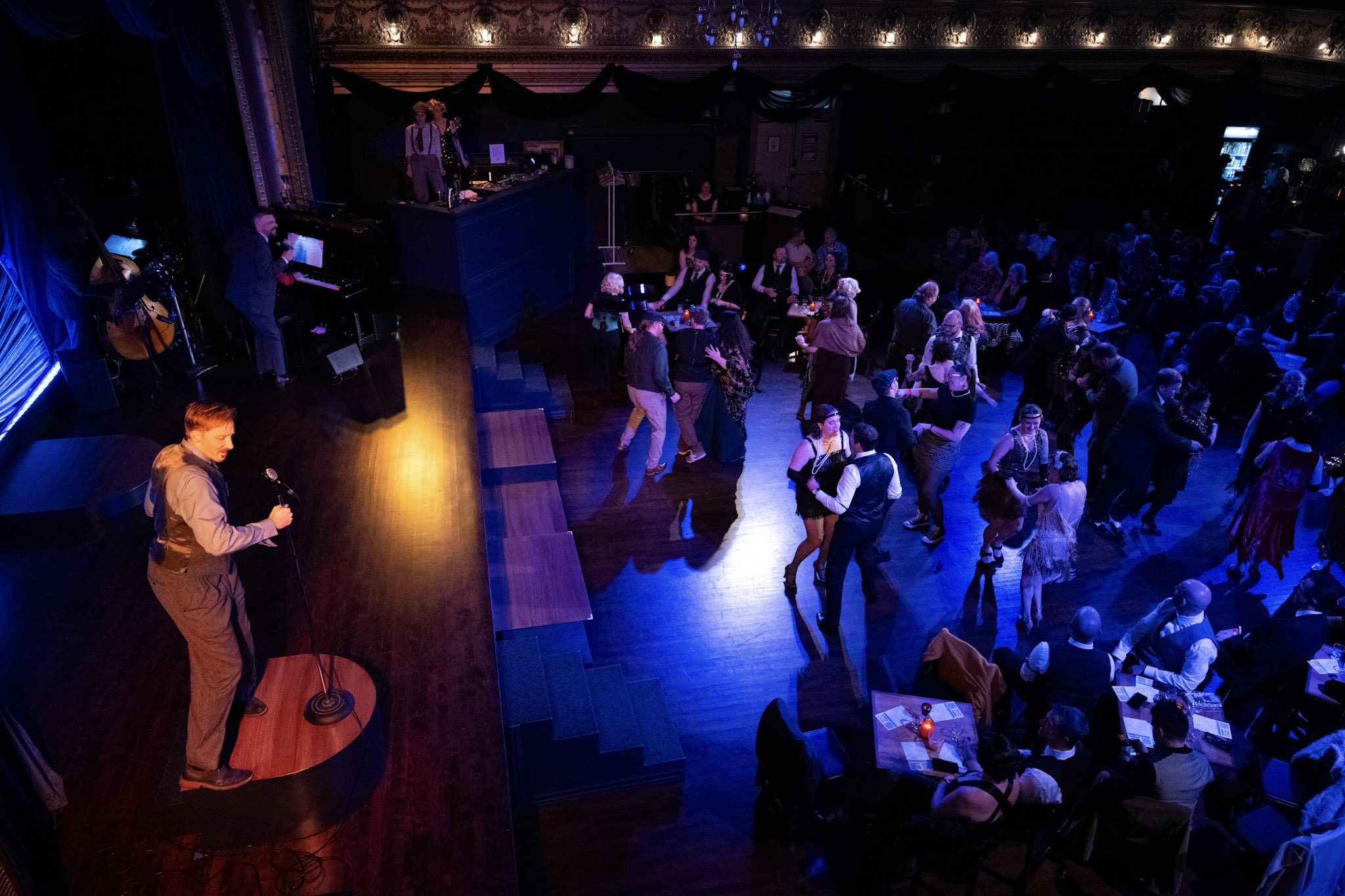
Bootlegger’s Ball, that thing I created, 2026. Bruce Clayton Tom.